One of the top requests we get is for help with a closet pantry. The pantry is one of the most important parts of the kitchen but is often poorly optimized. Before we dig into the FAQ, let’s set some definitions of the types of pantries:
- Cabinet Pantry – this is exactly what it sounds like. Typically, it is a 7-8’ tall cabinet with static and equally spaced shelving. The cabinet pantry tends to be about 24” deep and varies by width. From an installation standpoint, it doesn’t get easier than this!
- Step-in Pantry – these can be tricky as you usually have challenging angles and shallow walls. The design becomes a balance of space, convenience, and accessibility.
- Walk-in Pantry – this is often a world of endless possibilities. Drawers on all sides? Drawers plus shelving? Do you add cabinets up top? Do you have countertops and a work area? Walk-in pantries are the most complex to both design and install.
And finally . . . .
- Closet Pantry – a closet in or just off the kitchen that has been converted to a pantry. It is typically 22 – 24” deep with 4-6” on the inside of the door frame. Most builders install wire racks ranging from 12 – 14” deep and evenly spaced vertically.
FAQ: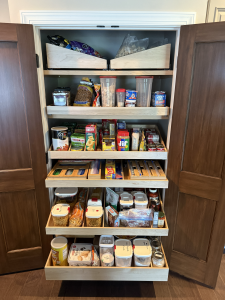
Q: How much space is lost in a cabinet pantry?
A: Let’s take a closet pantry that is 24” wide from wall to wall with five wire racks. The square footage of storage with standard wire racks is 11.67 square feet. When we install shelving that considers the full size of the closet and add drawers on top for access, the available square footage increases to 17.5 square feet or 50% more. This will hold true for any size closet.
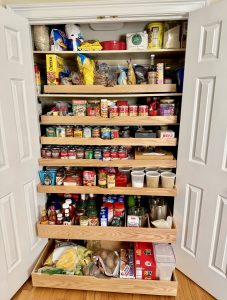
Then, if you change how you organize your pantry (see tip below), you can add at least another two shelves and drawers. This will increase your storage to 22.16 square feet or 90%. Almost double the capacity of your existing pantry.
Q: How do you prevent losing space on the sides?
A: This is by far the number one concern. In closet pantries, our drawers must sit on shelving since they can’t “float” like they do in a cabinet pantry. We install ¾” or ½” pre-finished shelving with edge banding across the entire width of the closet. Then, our drawers are installed on top of these shelves so they can pull out between the frame of the door. Clients store less used items on the sides and put the most frequently used items on the drawers for better access and organization.
Q: What can be done on the bottom of the closet?
A: You have three main choices:
- Keep it open – this is a popular choice. Many clients have become accustomed to keeping large bulk items like a case of water or a container of dog food at the bottom. If that is the case, we fully support keeping that as-is. Often, the first wire shelf has been set too high, and you lose space. So, we like to start the first drawer / shelf combo a little lower while accommodating your tallest bulk item.
- Install a drawer – if you are open to change, we can install a drawer into your floor so it pulls out to help with accessibility. You will still have plenty of space on the sides of the drawer just inside the door frame.
- “Install” a cart – if you are uncomfortable installing a drawer in the floor but still crave the access to those items, we can put nylon caster wheels on the bottom of a drawer to create a mobile cart. It gives you the convenience of the drawer without the permanence of an installed drawer.
Q: What do you do at the top of the closet pantry?
A: Most closets have 2-3 feet above the door frame to the ceiling, and this is space that can be tough to use. A best practice is to install a half-shelf which is between 12 – 14” deep. This is an ideal place to store large cereal boxes or taller items like paper towels and large bottles. While a shallower shelf does sacrifice some space, you gain a lot in flexibility. For most people, reaching to the back of a full depth top shelf is not possible. Our design goal is to balance accessibility with space.
Q: What are best practices when it comes to organization?
A: To maximize the space in your pantry, it is important to store like-sized items together meaning cans and jars on one shelf and boxes of pastas and crackers on another, for example. You also want to put the items you use more frequently at the easy-to-reach level and the less frequently used items a little higher or lower in your pantry. If you are an organizational freak like us, you can use dividers to keep like items together in neat rows or columns.
Q: What if you have a two-door closet pantry?
A: In some kitchens, we encounter larger closet pantries with two doors. You have two options in this case: (1) one large drawer that spans the width of the doors, or (2) split the space and have a set of drawers on each side. The benefit of the first option is slightly more space; however, you will need to open both doors anytime you want to pull out the drawers. The section option requires twice the number of drawers and a little more construction. The decision will be based on a combination of budget, space, and habits.
Q: What are some creative ideas to consider?
A: The options are endless, but there are a couple of things we’ve done with our clients to increase the value and utilization of their pantry:
- Divider shelf – storage is an issue in every kitchen. We can install divider shelves in the pantry to help you store cookie sheets, cutting boards, platters and other flat items. Great for the bakers and entertainers that need more storage.
- Spice drawers – use the drawers to store your spices face up making them easier to find. Great for the cooking enthusiasts.